
Unique Blend of Actuarial Analysis and Consulting Skills To Solve Complex Issues
Expert at People Or Community Related Problems
Guardian Actuarial specialises in solving problems that are related to people or community scenarios with complex operating environments.
“Translating human behaviour and problems into data to help reveal the insights you need to identify solutions”
Determining solutions to your problem
The way we approach a problem is to start with what is known, what’s not and then we work forward from there. We will always take a quantitative and qualitative approach to the problem.
Working collaboratively with our clients, each project is designed ensuring that we take a holistic approach and are not limited to existing data sets.
We are good at:
Articulating human elements of problems by qualitative data capture and turning into interrogatable data
Looking at a problem in a unique and holistic manner to gain a complete understanding of the problem.
Bringing together disparate data sets and knowledge to discover new correlations and connections.
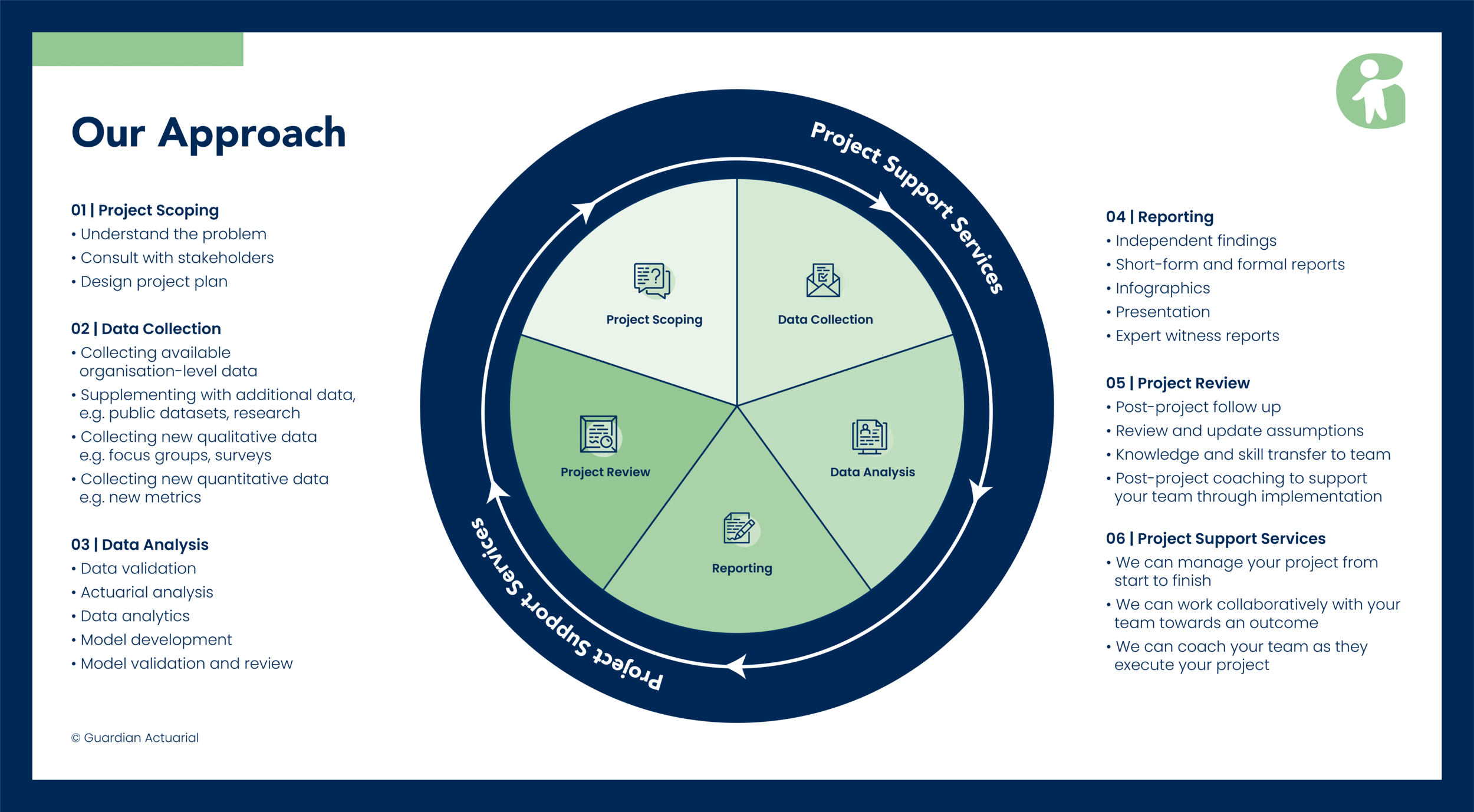
Our process
-
Project scoping includes the following key elements:
Understand the problem
Consult with stakeholders
Design project plan
Understanding the problem
Our first step in an engagement is spending time understanding the problem. Quite often this requires us to design new lines of enquiry and data capture to properly understand the full scope. Our special skills are eliciting all the internal knowledge about a problem and then determining what else is required. We will also look at what qualitative data capture is required to add to your understanding of your organization and those that you service and you staff.
Validate the understanding and scope
To ensure we are focused on the right things, we take time to further validate the understanding of the problem. This step is vital as with all complex problems, there will be several considering factors which may dominate or override other key issues sitting within the problem. This step ensures we are focused on the right things to start providing solutions.
Download our Project Planning Tool to help you start planning your data-driven project.
-
Data collection may include:
Collecting available organisation-level data
Supplementing with additional data, e.g. public datasets, research
Collecting new qualitative data e.g. focus groups, surveys.
Collecting new quantitative data, e.g. new metrics
Collect all data required to properly analyse the scope of the problem
Once the problem is properly understood we move onto capturing or discovery any additional data required to help with a complete analysis of the problem. This will likely involve a return to the initial scope of the problem should anything arise that makes us question the original approach.
Read a recent example of how we combined existing and new data to solve a complex people-oriented problem.
-
Data analysis could include:
Data validation
Actuarial analysis
Data analytics
Model development
Model validation and review
Identifying potential solutions
With the complete picture understood, we start the process of correlating and determining themes and key points of the problem. These allows us to then identify and explore potential solutions.
Crunching numbers for all solutions and making recommendations
Inevitably there will be multiple potential solutions. Each potential is modelled to understand outcomes, budget and any other impacts or considerations. The objective is to provide a data driven set of solutions for consideration by our client, complete with validation of the numbers.
Read a recent example of how we used data analysis to solve a complex people-oriented problem.
-
We present our results in way that is meaningful for you and your stakeholders. This could be in the format of:
Independent findings
Short-form and formal reports
Infographics
Presentations
Expert witness reports
and more…
Take a look at a sample infographic.
-
We like to check in after your project is delivered. This can include:
Post-project follow up following completion
Reviewing and updating assumptions
Supporting knowledge and skills transfer to team
Post-project coaching to support your team through implementation
-
We provide the right level of project support to you and your team. Depending on your preference, we can:
Manage your project from start to finish
Work collaboratively with your team towards an outcome
Coach your team throughout execution your project
““Our whole team has valued the way in which this project has evolved, and the flexibility of both Julia and Karen in helping us shape it up!”
- Executive Director, Child Protection Oversight Agency”